

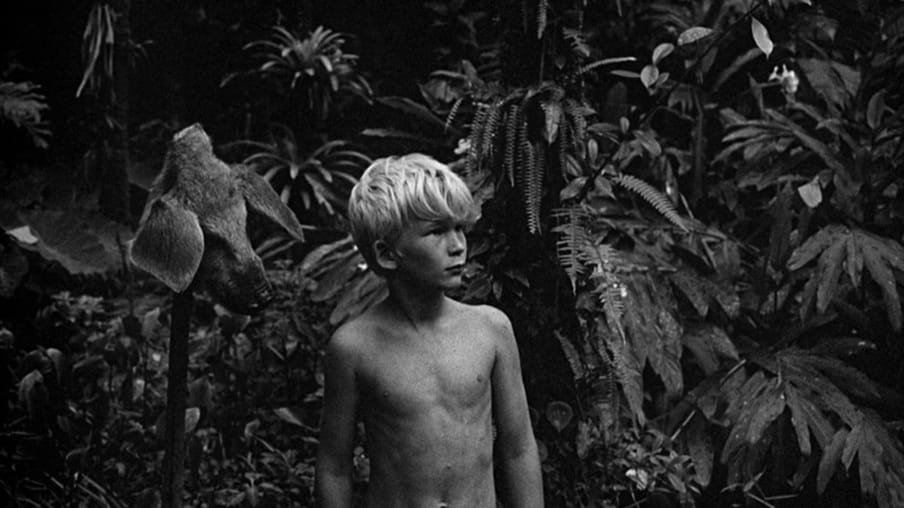
It started as a dream. Imagine: a plane crashes on a deserted island in the Pacific Ocean. The survivors are about twenty British schoolboys, aged between six and twelve. They can’t believe their luck. The beach, the shells, the water – it’s like they’ve stepped into a boy’s book. And even better: there are no adults.
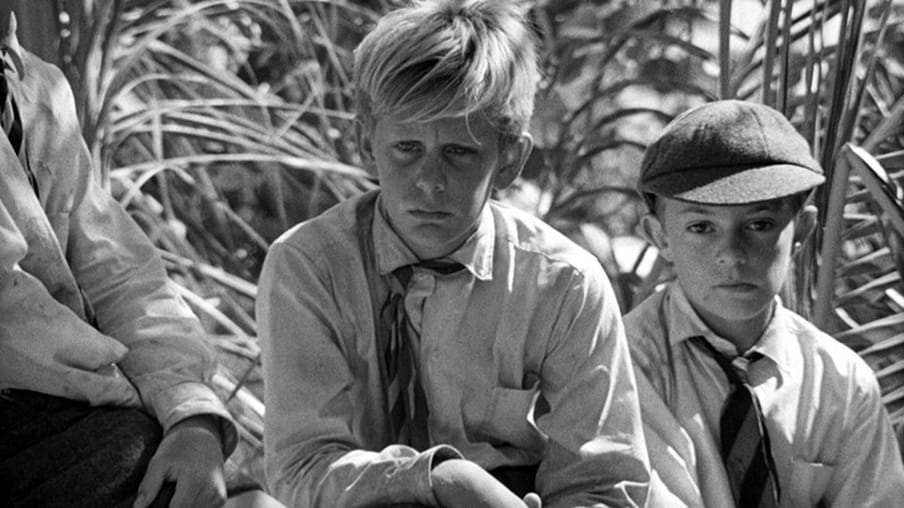
On the very first day, the boys establish a kind of democracy. One of them, Ralph, is elected leader. He has a three-point plan. One: have fun. Two: survive. Three: make smoke for passing ships.
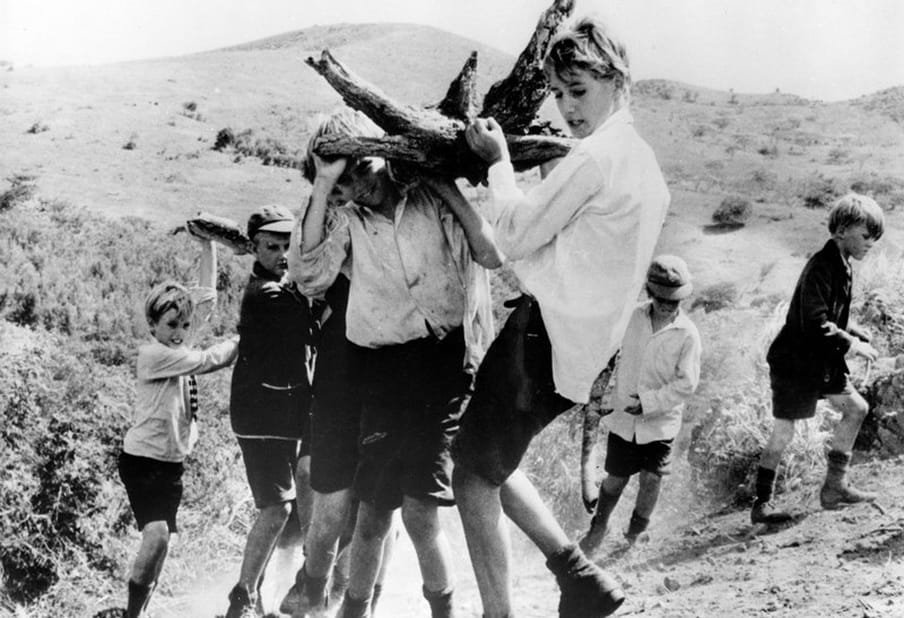
Only point one succeeds. Most of the boys seem to prefer playing and eating to tending the fire. One of them, Jack, prefers to hunt pigs. As time goes by, he and his friends become increasingly reckless. And just as a ship passes by, they abandon their post by the fire.
“You’re breaking the rules!” Ralph shouts indignantly.
Jack shrugs. “What difference does it make?”
“The rules are all we have!”
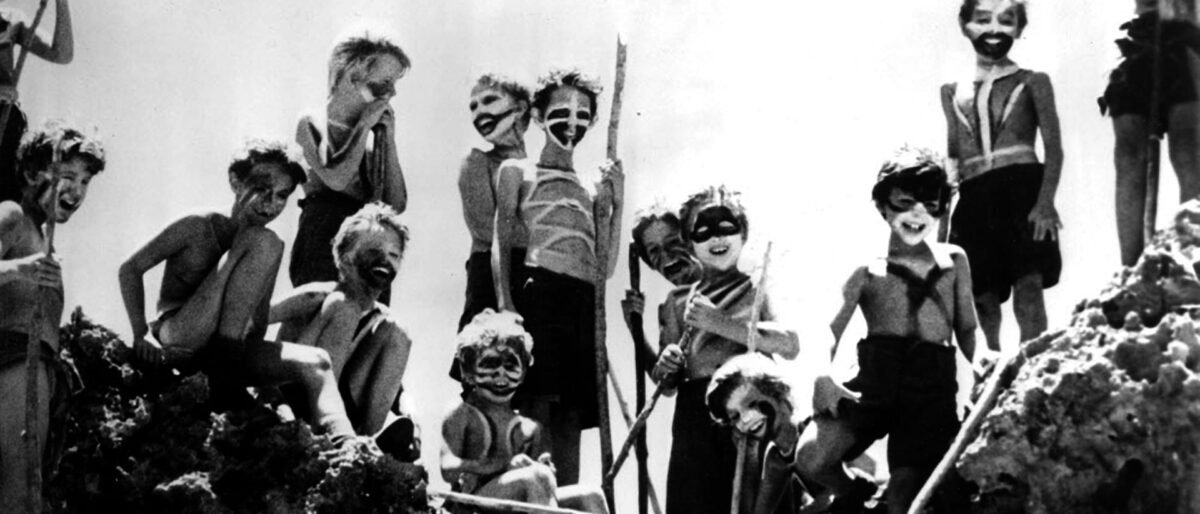
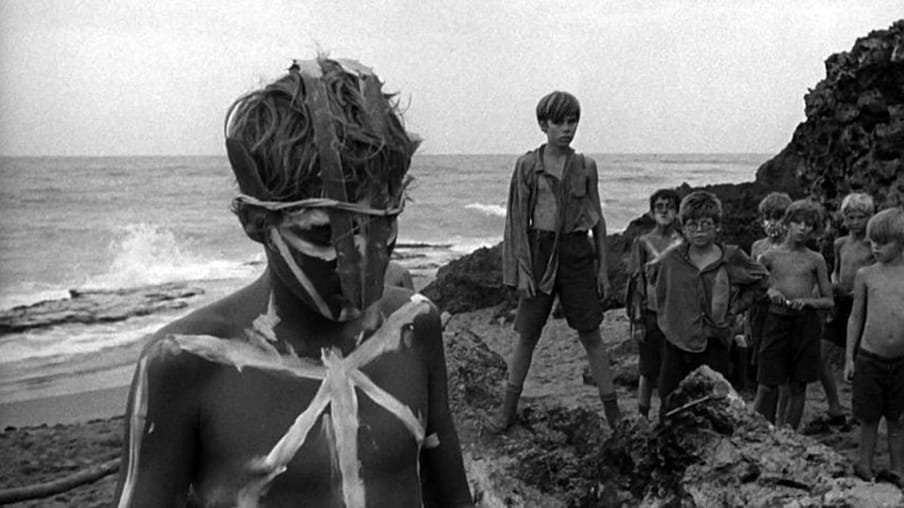
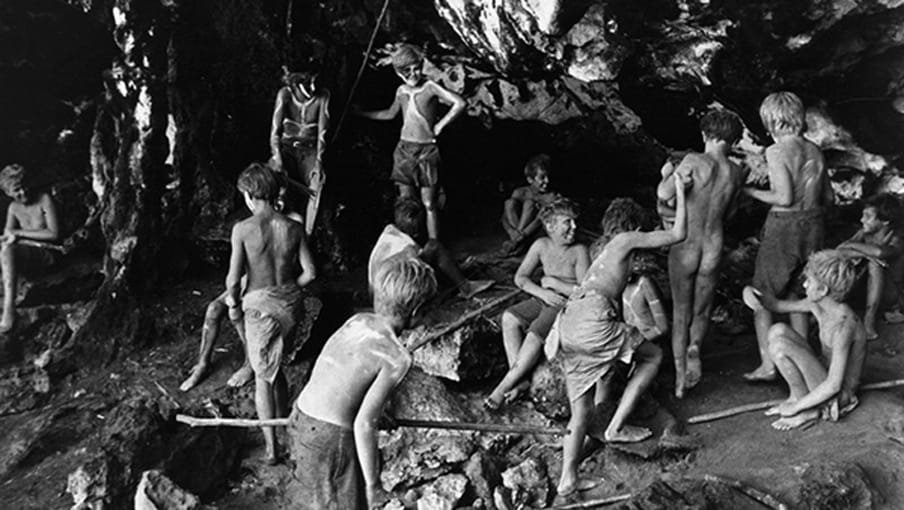
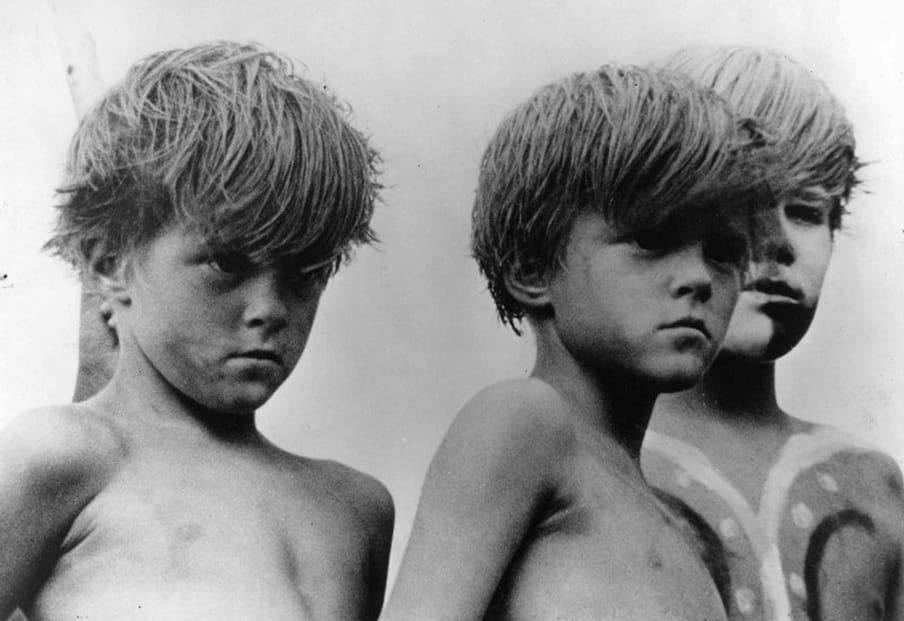
As darkness falls, the fear of a beast supposedly lurking on the island grows. But the real beast is within the boys themselves. They paint their faces and shed their clothes. Their desire to pinch, kick, and bite grows stronger and stronger.
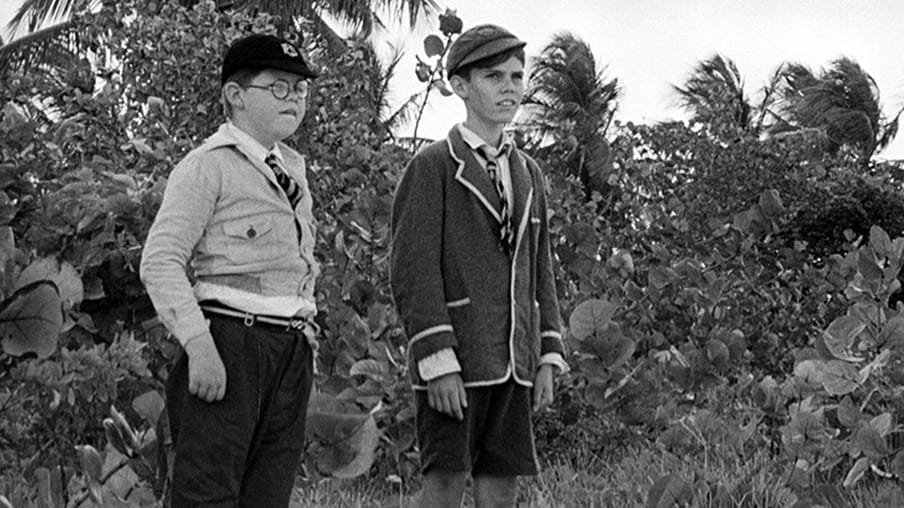
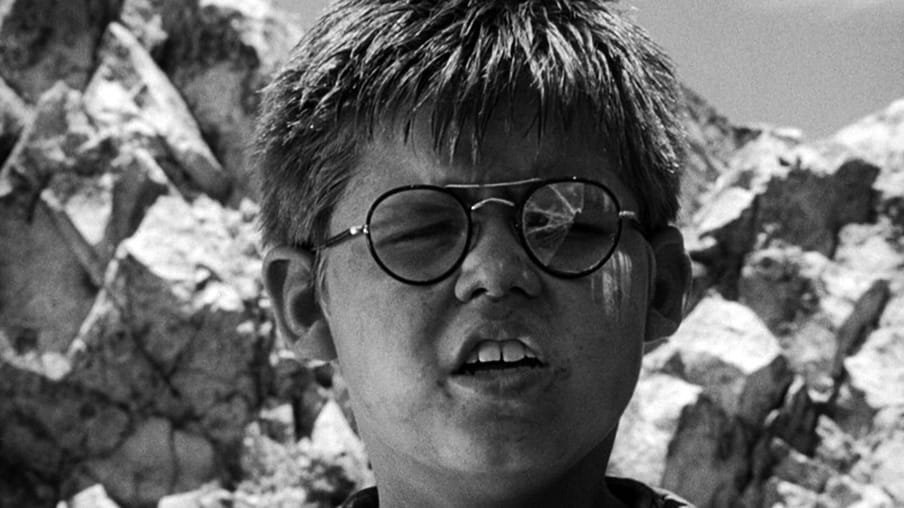
All the while, one boy, Piggy, keeps a cool head. Piggy is so called because he’s fatter than the others. He has asthma, wears glasses, and can’t swim. Piggy is the voice of reason, but no one listens. “What are we?” he asks desperately. “Humans? Or animals? Or savages?”
A little later, Piggy lies on the ground, murdered.
After months, a British officer finally sets foot on the island. The island is a smoldering ruin. Three children are dead. “I thought a group of British boys would behave better,” the officer sneers.
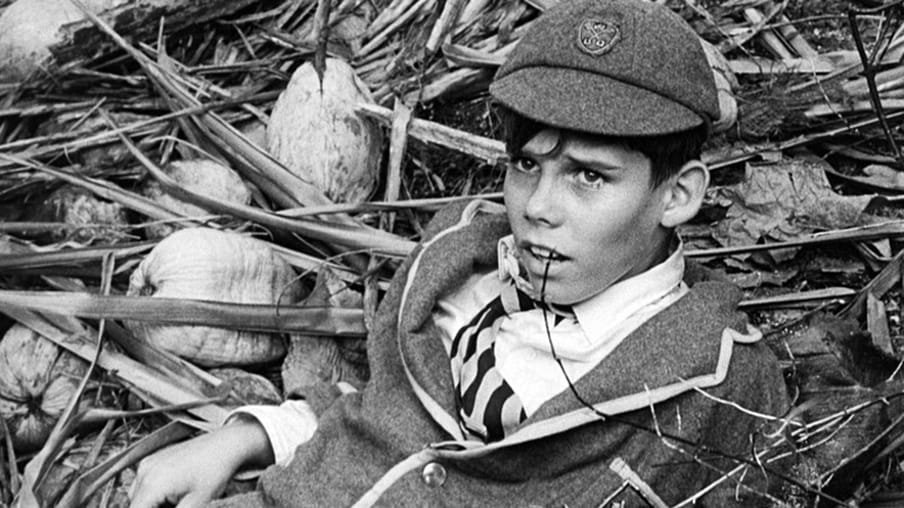
Ralph, once the leader of that well-behaved group, bursts into tears. “Ralph weeps for the end of innocence,” we read, “for the darkness in the heart of man…”
𝓲 Once you’re scrolling down, a top status bar will pop up to remind you of the article title and the reading time. The purple status bar all the way on the bottom of the screen shows your reading progress. Make sure you’ve tried our little Dark/Light background switch at bottom right (☼)! And on the bottom left, you can zoom text in or out for eye relief and reading comfort. Reading on a smartphone? Tilt landscape to find this function.
A classic is born
The above story is, admittedly, a fabrication from start to finish. It originated in 1951, in the mind of British writer William Golding. “Wouldn’t it be a good idea,” he asked his wife one day, “to write a book about some boys on an island, to show how they would really behave?”
“That’s a wonderful idea!” she replied. “Write it!” 1
Literary London proved less enthusiastic. When Golding’s manuscript arrived at the publisher Faber & Faber, it had already been rejected by many others. The first reader, a certain Miss Perkins, was also not impressed. “An absurd and soporific fantasy,” she noted. “Nonsense and dull. Pointless.”
But then a young editor fished the book out of the trash. No one could have imagined at the time how enormous Golding’s success would become. Ultimately, tens of millions of copies of Lord of the Flies would sell. The book was translated into more than thirty languages and became one of the greatest classics of the twentieth century.
Was Auschwitz an exception, or is there a Nazi in all of us?
In retrospect, the success is easy to explain. Golding demonstrated like no other what humankind is capable of. “Even if we start as a blank slate,” he wrote in his first letter to his publisher, “our nature still compels us to make a mess of it.” Or, as he later remarked, “man produces evil as a bee produces honey.”
Of course, the zeitgeist contributed: in the early 1960s, a new generation asked their parents about the horrors of World War II. Was Auschwitz an exception, or is there a Nazi in all of us?
Lord of the Flies suggested the latter and became a huge hit among young people. While war criminal Adolf Eichmann was on trial in Jerusalem and sociologist Stanley Milgram was conducting his infamous shock experiments (which also seemed to prove that civilization is only a thin veneer), schoolteacher William Golding became world-famous.
The influential critic Lionel Trilling argued that Lord of the Flies even triggered a “mutation in culture”: suddenly, the idea of original sin was popular again. Golding ultimately won the Nobel Prize for his work, which, in the words of the Swedish committee, “as realistic narrative art” brilliantly illuminates “the human condition in today’s world.”
The famous author Stephen King summarized it even more clearly in the preface to the latest anniversary edition: “Lord of the Flies: a perfect understanding of the kind of being my friends and I were at twelve.”
What would happen in real life?
I still remember well the first time I read it myself, years ago. I remember the book left me shocked, and I agonized over it for days. But I didn’t actually doubt Golding’s view of the dark side of humanity. There’s something in human nature that makes us believe the worst about that same nature.
What I didn’t know at the time is that in 1954—the very year Lord of the Flies was published—a real experiment was also conducted with about twenty schoolboys. Not fiction, but science.
This research allows us to answer the same question: what happens when you let ordinary children run wild in an uninhabited wilderness? Does the beast within them spontaneously emerge, or is something else going on?
The Robbers Cave Experiment
This story begins on June 19, 1954. Twelve boys, around eleven years old, are waiting at a bus stop in Oklahoma City. They come from respectable, Protestant families. And that day, they couldn’t believe their luck. The boys are going to camp.
The destination: Robbers Cave State Park in southeastern Oklahoma. It’s a 20-acre area filled with hills, forests, and lakes. For the next three weeks, it will be their deserted island. What the boys don’t know is that they’re participating in a scientific experiment. And what they also don’t know is that another group will leave a day later.
What will happen in that first week of total freedom?
The research leader is Turkish psychologist Muzafer Sherif. He has been interested for years in how conflict arises between groups, and how peace can subsequently be restored.
Sherif has long anticipated this moment. Everything has been meticulously prepared. The instructions for the camp leadership are clear: let the boys do what they want. Anything goes, unless their safety is at risk.
During the first phase of the research, the two groups are unaware of each other’s existence. They are housed in separate camp buildings and believe they have the place to themselves. What will happen in that first week of total freedom? Will the boys behave as William Golding imagined children “really would” behave?
Friendship is born spontaneously, enmity is sown
Let me be frank: science is less exciting than fantasy.
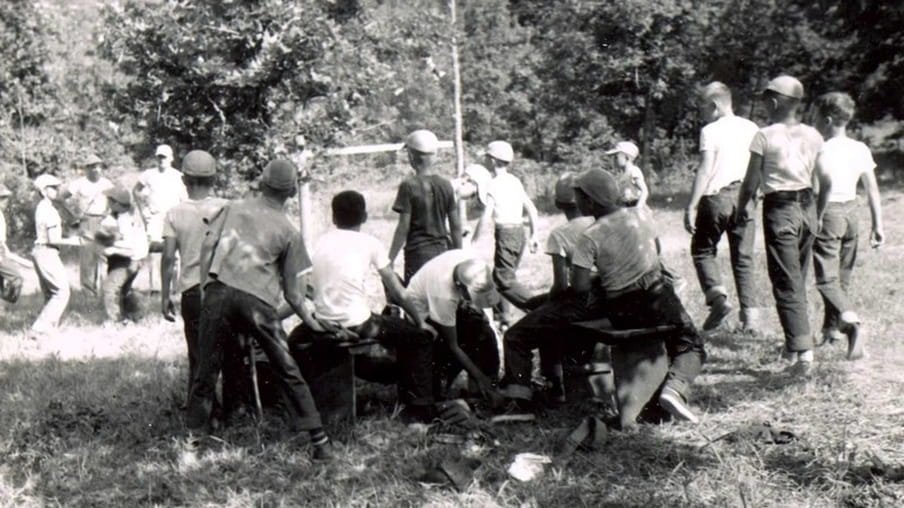
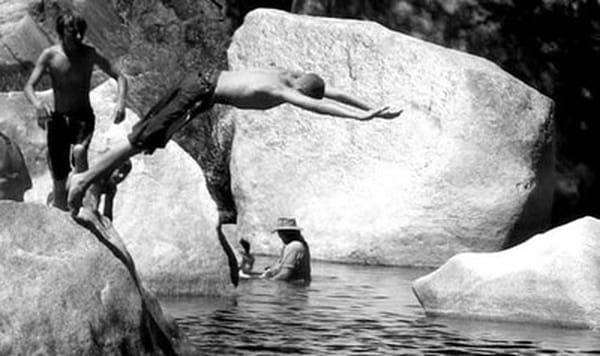
In that first week, the boys in both groups work together harmoniously. They build a rope bridge and a diving board. They grill hamburgers and set up a tent. They run and jump—and quickly become close friends.
There is one boy, Everett, who, like Piggy in Lord of the Flies, can’t swim. But he isn’t bullied. The members of his group form a protective circle in the water, after which little Everett dares to take the plunge. “He was praised by everyone,” the researchers would later note, “and called by his favorite nickname for the first time.”
But then the experiment takes a dark turn. In the second week, Sherif abandons his reluctance. From then on, he tries to pit the groups—who call themselves the “Rattlers” and the “Eagles”—against each other. “The goal of this phase was to control the conditions so that each group would view the other as a competitor,” the researchers would later note.
To begin with, the management organizes a tournament between the two teams that will last for days. Only games with a clear winner and loser, such as baseball and tug-of-war, will be played. There will be no consolation prize.
Meanwhile, the researchers manipulate the score to keep the teams neck and neck. “We were always busy with some task where we had to beat them,” one of the boys will later recall. “The staff […] encouraged the behavior that fit the hypothesis.”
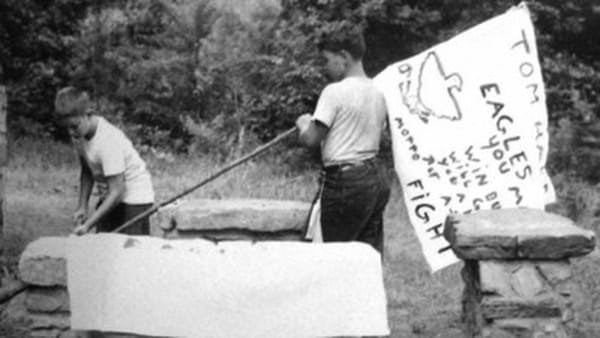
The Eagles, in particular, are initially not very enthusiastic about the tournament. “Maybe we can just be friends with these guys,” one of them says, “then no one has to get angry or dislike anyone.” When the Rattlers win the first baseball game, they praise the Eagles for their sportsmanship. But ultimately, it works: as the tournament progresses, the groups start to dislike each other. Things only really escalate when the Eagles burn the Rattlers’ flag (the staff gives them the matches). What follows are a few fights and raids where the groups trash each other’s sleeping quarters. Not that the boys are about to kill each other, but the atmosphere is thoroughly soured.
New research sheds new light
Yet, this isn’t the whole story, as I discovered when I delved deeper into the history of this famous experiment. In textbooks, students still read about the fight that “spontaneously” arose when the Rattlers and the Eagles encountered each other. But what few people know is that Muzafer Sherif had tried it before.
The Robbers Cave Experiment wasn’t the first attempt to sow discord; it was the third. The year before, it had ended in disaster. Sherif wrote that the experiment had to be abandoned “due to various difficulties and unfavorable conditions.” Sixty years later, psychologist Gina Perry discovered exactly what had happened. The two groups—the Panthers and the Pythons—had become such good friends that they were impossible to separate.
The staff grew increasingly frustrated with the boys’ kindness. One of the researchers pulled down a tent, hoping to blame the Panthers. To his frustration, the children helped each other rebuild it. The staff then raided the Panthers, hoping to blame the Pythons. Once again, they came to each other’s aid.
Eventually, the children realized they were being manipulated. One of them found a notebook with detailed observations, after which the experiment had to be halted. “I think we got to know each other quite well in the first few days,” one participant recalled, “and it seems that when you have friends, it becomes a bit harder to really compete. That sounds like common sense, doesn’t it?”
All in all, the experiment left an indelible impression on the participants. “I’ve changed my mind about a lot of things,” one of them recently said. “It’s very encouraging.”
William Golding’s view of humanity
While these boys were learning the lesson of a lifetime, William Golding, 7,000 kilometers away, sat hunched over his desk. The British writer didn’t research his novels; he let his imagination run wild. “The nature of Man with a capital M,” Golding wrote in his diary, “became a more pressing matter for me than actually meeting people.”
Throughout his career, Golding was withdrawn. He hated interviews and revealed little about his personal life. Only recently have we come to know the real Golding. In his biography, written by the British critic John Carey, the image of a nasty man emerges.
For example, Golding had a poor relationship with his son and was a terrible teacher to his class. In his memoirs, to which Carey was granted exclusive access, Golding even admitted that as a student he had tried to rape a girl (“Shut up, you stupid whore, I’m not going to hurt you,” he snapped at her). The further I got into that 592-page biography, the better I understood where Golding got his ideas. “I’ve always understood the Nazis,” he confessed, “because I was naturally the same.” And it was “partly out of sad self-knowledge” that he wrote Lord of the Flies.
There was one other source of inspiration for the book, as the memoir reveals: Golding also conducted experiments on his own class. Like Muzafer Sherif, he deliberately sowed discord among his students and then observed their reactions. As the leader of a school trip, Golding divided his group into two: one team for the defense, and one for the offense.
Years later, the author boasted that he had managed to penetrate the child’s soul with “terrifying precision” because he had unleashed “a certain degree of experimental science” on his class. “My eyes bulged when I saw what was happening.”
How enemies become friends again
No one knows exactly what happened—even biographer John Carey, after years of research, hasn’t been able to figure it out. What we do know is how things turned out for the Rattlers and the Eagles.
During that third attempt, in late June 1954, the stakes were high for Sherif and his colleagues. The money was running low, but they had finally managed to pit the boys against each other. And so, in the final week of the experiment, Sherif arrived at his main question: How do you turn enemies into friends?
The answer would make him world famous.
The researchers first tried fun things: having breakfast together, watching movies, swimming, setting off fireworks—to no avail. Then they presented the children with a series of shared challenges. For example, they pretended the camp’s water supply was broken.
As they neared home, the boys began to sing. They exchanged addresses and promised never to forget each other.
And then it happened. The boys started working together. The real turning point came when the leaders pretended one of the trucks was broken. The children quickly agreed that the vehicle needed to be pulled. So, the rope (which had been used in the tournament the week before) was brought out to get the truck “running.”
After the boys had been pulling with all their might for a few minutes, one of the scientists started the truck again. “Yeah! We won the tug-of-war against the truck,” an Eagle shouted, after which the boys clapped each other on the back.
Once again, I realized that little remains of Golding’s view of humanity. Remember: in Lord of the Flies, the group was destroyed by disaster, but in Oklahoma, it brought the boys together.
At the end of the week, the boys asked if they could go back together on the same bus. On the way, one of the Rattlers remembered that his group had five dollars left—prize money won during the tournament. It was quickly decided to buy milkshakes for all the children. As they neared home, the boys started singing. They exchanged addresses and promised never to forget each other.
The thick blanket of civilization
492 hours of observation, 1,200 photographs, hundreds of hours of recordings – the Robbers Cave Experiment was a massive project. To this day, it remains a milestone in social psychology.
Since then, much more research has been published on the behavior of young children. This literature shows that we are susceptible to us-versus-them thinking from an early age, especially when it is stimulated from above (as in the second week of Sherif’s experiment).
But there is also a library of evidence that from an early age we are imbued with the urge to help each other (as in the first week) and that shared challenges can bring us together (as in the third week). Humans are, after all, social animals; we are not born cosmopolitan. 200,000 years ago on the savanna, we already worked together in small groups. But that doesn’t mean that the boundaries are predetermined. Toddlers, for example, don’t exhibit any characteristics of racism; they don’t care who they play with. And the circle of loved ones we care about can also grow. 2
I wrote previously about what happens after natural disasters: not an explosion of selfishness, but of altruism. Then civilization turns out to be not a thin layer, but a thick blanket that keeps us all warm. That is to say: when life gets tough, we don’t fall over each other. In the face of disaster, we grow closer together.
The consequences of such a dark image of humanity
You might say: oh, what does it matter? People understand that books like Lord of the Flies are just entertainment.
But stories are never just stories. What we tell is what we become. Recent research by psychologist Bryan Gibson, for example, shows that watching manipulative reality TV can make people more aggressive. The link between children who consume violent media and aggression later in life is even stronger than the link between asbestos and cancer, or the link between calcium intake and bone mass.
Even more important is the effect on our worldview. British researchers found that girls who watch more reality TV are more likely to say that you have to be mean and deceitful to get ahead in the world. 3
Dozens of studies show that television can make us more distrustful and anxious. For example, TV addicts are more likely to agree with statements such as “Most people only think about themselves.” The founder of this field of research – Professor George Gerbner (1919-2005) – also spoke of the Mean World Syndrome. 4
“Those who tell the stories of a culture,” Gerbner said, “control human behavior. Once upon a time, it was the parent, the school, the church, the community. Now it’s a handful of corporations with nothing to say but a lot to sell.”
The consequences of such a dark image of humanity
I think it’s time to tell a different story.
Of course, every one of us has evil within us. Children bully and adults wage war. But most of the seven billion souls on this earth are more concerned with living together and loving than with hurt and hate.
That vast majority may not be good for ratings, nor does it provide material for international bestsellers that win the Nobel Prize for Literature. But that majority does make this life, on this earth, worth living.
One of the boys in Sherif’s second experiment wondered years later about how distorted our view of humanity is. The experiment had taught him that friendships develop spontaneously, and that it is difficult, very difficult, to drive friends apart. “Sometimes I think,” he sighed, “that the rest of the world should also know about this sobering fact.”
Researcher Felix Warneken conducted a series of heartwarming experiments that showed that even very young children spontaneously help a stranger.
Footnotes
- Biographer John Carey describes this conversation between Golding and his wife. ↩︎
- See the book Just Babies: The Origins of Good and Evil by Paul Bloom. ↩︎
- See this British study on the effects of reality TV ↩︎
- The book “Media Effects: Advances in Theory and Research” offers a useful overview of this branch of psychology. ↩︎
Source
This article was translated by CommonTruth.app from the authors’ original dutch, publicated 6th june 2017 in De Correspondent.